Originally Published as: The Effect of CFS on Insurance and Financing: How cold-formed steel framing is reshaping risk assessments, premium calculations, and lending decisions for metal building projects
Request editorial topic coverage by reaching out to Kathleen Riley at kathleen@shieldwallmedia.com.
For years, the case for cold-formed steel (CFS) in post-frame and metal building construction centered on strength, speed of erection, and resistance to pests and rot. Increasingly, though, the strongest argument may be showing up somewhere builders don’t always think to look first: the insurance binder and the loan document. As underwriters and lenders sharpen their tools for pricing risk, the material a building is framed with is starting to carry real, measurable weight in what it costs to insure and finance.
Fire Resistance Moves the Needle on Premiums
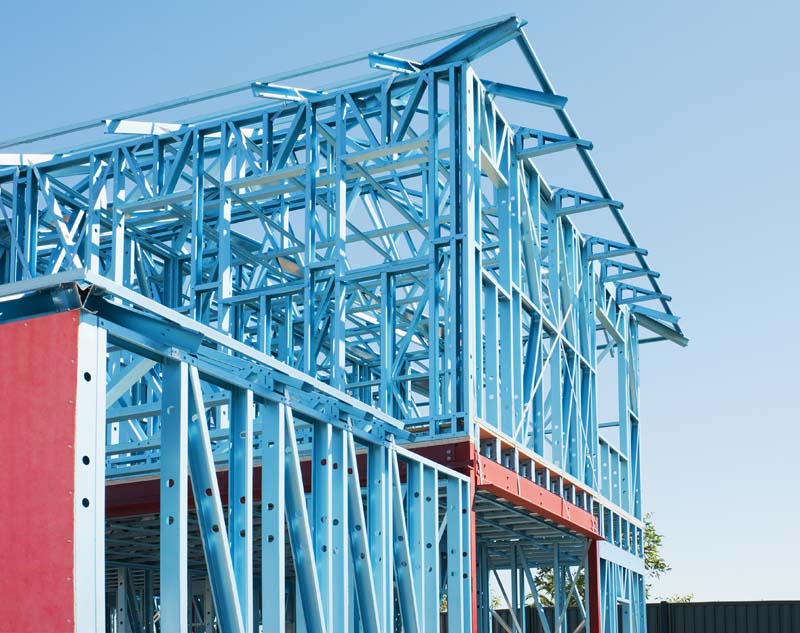
Builder’s risk insurance — the policy that covers a structure while it’s under construction — has become a growing point of leverage for steel. Because CFS is non-combustible and does not add fuel to a fire, insurers increasingly treat steel-framed projects as a lower-severity risk than comparable wood-framed ones, particularly during the vulnerable construction window before fire suppression systems are active.
Builders could save 25 to 75 percent on risk insurance by building with steel.. That range isn’t theoretical. Trade coverage has pointed to real project comparisons — one cold-formed steel hotel project carried a builder’s risk premium of roughly $92,000, versus $450,000 for a similar wood-framed project, a difference of more than 75 percent. Industry sources also point to a run of high-profile construction fires on wood-framed multifamily and commercial projects in recent years as a factor pushing underwriters to re-price risk on combustible framing more aggressively, even outside catastrophe-prone regions. The Midwest the past two years have actually had the most property losses from tornados and lightning-related damage.
Wind and Hail Performance Factor In, Too
Fire isn’t the only performance category insurers are watching. Wind and hail losses have become one of the fastest-growing drivers of property insurance costs nationally, and roof and wall assembly performance is now a standard part of how policies get priced. The Insurance Institute for Business & Home Safety (IBHS) maintains the FORTIFIED construction standard, which several states now require insurers to offer discounts for structures built or retrofitted to meet it. In some markets, wind and hail discounts under FORTIFIED have run as high as 45 to 55 percent, depending on the insurer and the state.
Metal roofing and panel systems with a UL 2218 Class 4 impact rating—the highest hail-impact classification—have separately qualified for discounts in roughly the 10 to 35 percent range in several markets, according to insurance-industry reporting. For post-frame and metal building owners in hail-prone regions of the Midwest and Plains, that combination of non-combustible framing and impact-rated roofing is increasingly something an agent can quantify on a quote, not just a talking point in a sales pitch.

What It Means When the Building Goes to a Lender
On the financing side, the picture is more nuanced. For most commercial and agricultural lenders, industry guidance is consistent: the framing material itself is rarely the deciding factor in whether a loan gets approved. What matters more is the building’s use, its income-generating potential, the strength of the borrower’s plans, and — critically — the as-completed appraisal.
From a lender’s perspective, the building material is less important than the building’s use, condition, value, and income-generating potential. That said, appraisal and comparable-sales data can still work against a project simply because fewer directly comparable metal-building sales exist in a given market, which is where relationship lending tends to matter. Farm Credit institutions and other agricultural lenders, along with local community banks, are frequently cited as the most metal-building-fluent financing sources, largely because they underwrite based on long-term durability and construction quality rather than defaulting to a generic appraisal model built around wood-framed structures.
Engineered, pre-manufactured building systems also tend to produce more predictable construction schedules than site-built framing, which several financing sources note is itself a factor lenders weigh favorably — a clearly scoped, engineered project with a defined draw schedule is simply easier to underwrite than one with more construction-phase uncertainty.
The Takeaway for Builders and Their Clients
None of this means every steel-framed project automatically gets a lower insurance bill or an easier loan approval — discounts vary by state, insurer, and lender, and documentation requirements (like a verified FORTIFIED or UL 2218 rating) usually must be met before a discount applies. But the direction is clear: fire performance, wind and hail resistance, and construction predictability are all becoming line items that insurers and lenders can price, not just qualitative selling points. For builders, that means the conversation with a client’s insurance agent or loan officer is worth having earlier in the process, not after the building is up.
Note: Insurance and financing terms vary significantly by state, insurer, lender, and project type. Builders and owners should confirm current discount programs and underwriting requirements directly with a licensed insurance agent and lender before relying on any figures cited here.
Sources
- FRAMECAD – framecad.com/
- BuildSteel.org (Steel Framing Industry Association) buildsteel.org
- Institute for Business & Home Safety (IBHS) fortifiedhome.org/incentives/
- Crestmont Capital crestmontcapital.com
- Steel Structures America. steelstructuresamerica.com
- Steel Framing Industry Association (SFIA) — buildsteel.org