
Originally Published as: The Big-Door Business: Schweiss Doors
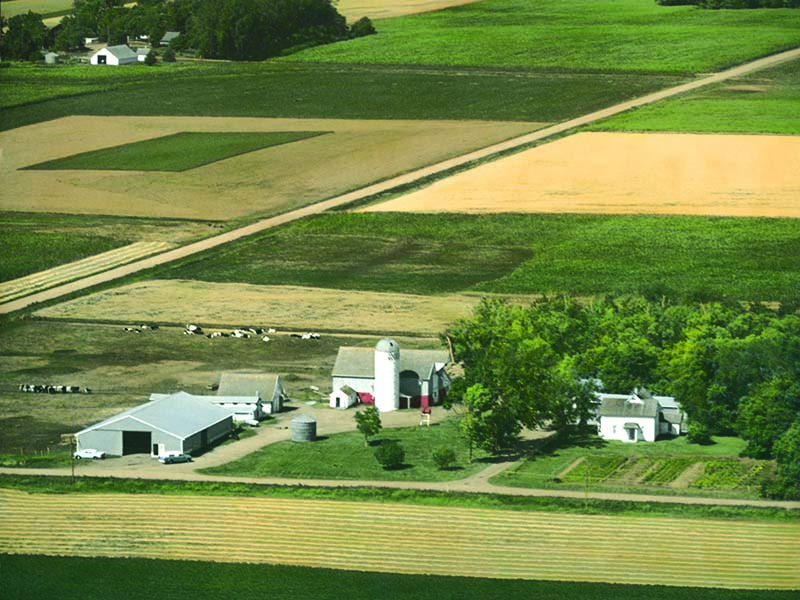
Mike Schweiss started with a chicken plucker and an idea he picked up at a wedding dance. Forty-six years later, his family company hangs doors on farm shops, NBA arenas and rocket hangars from a factory on the home farm in Renville County, Minnesota. Next, it wants to build the building, too.
In 1980, at a wedding dance at the Gibbon Ballroom in southern Minnesota, a man approached Mike Schweiss with a business idea. Schweiss had quit milking cows four years earlier and ran a small shop that built what farmers needed: farrowing crates, trailers, tile plows, snowblowers, and a mechanical chicken plucker that carried his name around the countryside. The man wanted to know whether he would consider building bifold doors. See me next week, he said, and we’ll talk.

The meeting never happened. As Schweiss has told the story many times since, the man died of a heart attack on the dance floor later that night. The idea outlived him. About six months later Schweiss built his first door, a 14-by-14-foot bifold for a county highway department shed in Franklin, about 10 miles from his shop. “We made it wrong every which way,” he said years afterward. The door is still in service.
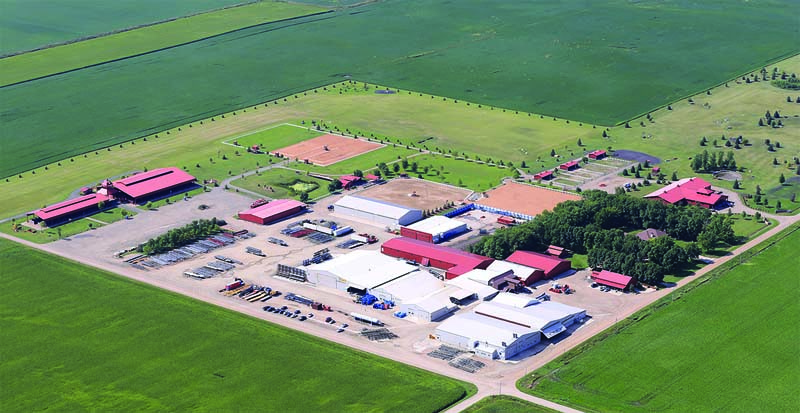
The company that grew out of that door now runs a plant of about 350,000 square feet on the Schweiss family farm outside Hector, Minnesota, equidistant from Hector and Fairfax and two hours west of the Twin Cities. Schweiss Doors employs about 65 people and says it has delivered to every continent. Its products open farm shops across the Corn Belt, the main entrance of the Sacramento Kings’ arena, and SpaceX rocket hangars at Cape Canaveral. It is privately held and family-owned, and it does not disclose sales figures.
What makes the company worth a close look is how narrow it has stayed. For more than four decades, Schweiss has sold essentially one thing: a very large door that lifts out of the way and clears the opening. Large doors are the core business, the company says, and never a sideline. That discipline is about to be tested. Schweiss is finishing a third door design, and it is developing a product that will get every reader of this magazine’s attention: metal buildings.

Out of the milking parlor
Schweiss graduated from high school in 1971 and went to work on the family dairy. Farm income was what it was, so he started building chicken pluckers in his spare time for extra money, then expanded into hog equipment, trailers, and a dozen other farm items. When drought hit the region in 1976, he already had three full-time employees. He got out of dairy and put his time into the shop, which, by the company’s account, began in what had been the milking parlor.
The chicken plucker mattered more than its name suggests. Schweiss has credited it with giving the business both name recognition and its early cash flow. At least one current door customer, a farmer near Atwater, Minnesota, has said he first knew the Schweiss name from the plucker his father owned.
That farmer-to-fabricator path is common in this part of the state. Loftness Manufacturing, also in Hector, was started by a farmer in 1956, and the regional development foundation notes that manufacturing employs a larger share of workers in southwest Minnesota than it does nationally. Schweiss fit the pattern, with one difference: Once he found doors, he dropped nearly everything else.
The door business started slowly. He has said the company sold one or two doors the first year, found customers by running a newspaper ad and waiting for the phone to ring, and grew one sale at a time. Through the 1980s, nearly all of those sales were to farms. He was a farmer selling to farmers, and he understood the problem they were trying to solve.
That problem kept growing. When Schweiss began, a 20-foot-wide door was typical on a machine shed. He pushed to 24 feet, then 30, then 36. By 2015, he called a 40-by-18-foot door common on farms and reported plenty of 50-footers. Combines, sprayers and planters have kept getting wider, and every increase retires another generation of sliding doors.
The Oshkosh effect
The second market arrived by invitation. In 1990, a friend brought Schweiss along to the Experimental Aircraft Association’s annual fly-in at Oshkosh, Wisconsin. He came home having met hangar owners from around the world with the same problem his farm customers had: more expensive equipment parked behind the door. Hangar doors, he has said, moved the business up a level.
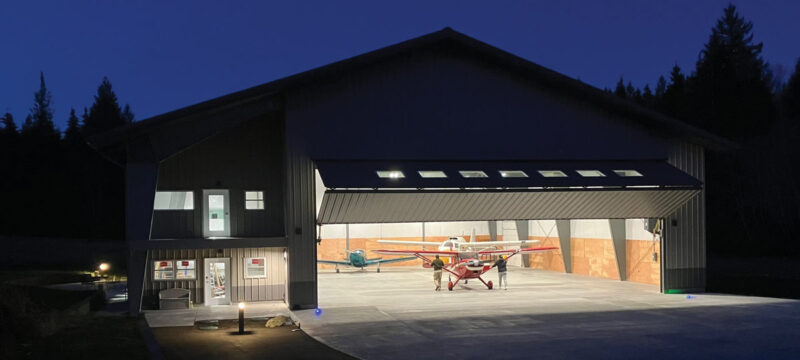
He also caught the flying bug, soloing in a Cessna 172 in 1991. And he found a sales tactic that suited him: Any prospect who wanted a hangar looked at could have his time for free by flying into the Hector airport to pick him up. He collected many airplane rides that way. One of the company’s largest single aviation orders went to Bult Field, a private airfield near Chicago, which was re-equipped with 132 Schweiss liftstrap bifold T-hangar doors. In April 2024, the Minnesota Aviation Hall of Fame inducted him for the strap-lift bifold and the one-piece hydraulic hangar door.
Trucking warehouses followed in the mid-1990s, then glass-clad doors for shopping centers and restaurants. In 2015, Schweiss put the mix at about half agriculture and 30% aviation, and he was candid about why he liked a spread: When aviation softened in 2009, agriculture was picking up. The balance has since shifted toward the airport. The company now puts aviation and agriculture at 40% each, with commercial and industrial work and Designer Doors at 10% apiece.
“I just can’t stop
thinking about them.”
MIKE SCHWEISS, ON DOORS,
IN A 2015 PROFILE
Cutting the cable
If one product decision explains the company’s position, it is the liftstrap. For decades, every bifold door on the market was raised by steel cables winding onto a shaft. Cables fray, rust, overwrap, and need adjusting; when one lets go, something valuable is usually parked underneath. Schweiss replaced them with wide polyester straps and began the patent process in 1998.
The engineering case is simple enough to make at a trade show booth. The company rates its 3-inch strap at 29,000 pounds of tensile strength, against 7,200 pounds for a quarter-inch cable. As the strap winds onto its drum, the effective diameter grows, so the door starts slowly and gathers speed as it rises. You can inspect a strap by looking at it. Schweiss backs the system with a 10-year warranty, and it later extended the idea to the latch, replacing cables, chains, sprockets and pulleys with a strap-driven autolatch that it says has 90% fewer moving parts.
Customers voted quickly. In the company’s own materials over the years, the share of Schweiss bifold buyers choosing straps climbs from 80% to 90% to 96%. The company says it now stands above 99%.
The shrewder move came in 2013, when Schweiss began selling a conversion kit that puts its straps on cable doors of any make. Every aging cable bifold in the country, including the ones competitors built, became a sales lead. It is an aftermarket business that doubles as a customer-acquisition program.
One piece, fewer parts
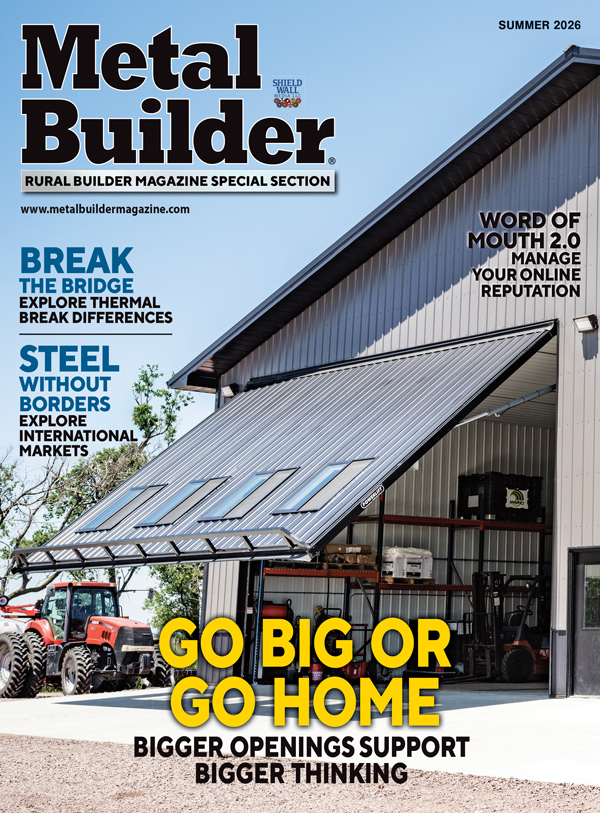
The other half of the catalog arrived in the late 1990s: the one-piece hydraulic door, a single rigid frame that swings out and up on two cylinders and forms a canopy when open. Builders and owners choose it for its clean appearance, large clear opening, relatively small number of moving components, and the fact that it needs less headroom than a bifold.
Since 2012 Schweiss has reworked the design one component at a time, and the sequence shows how the company thinks about product improvement: as a manufacturing exercise before it is a marketing one. A redesigned pump unit, branded Red Power, arrived that year. Larger cylinders ride on spherical bearings so they do not bind as the frame flexes. A wrap-around hinge with grease fittings followed in 2016. A vertical pump layout introduced in 2024 puts the motor, filter, gauges, and backup fittings within easier reach.
The most consequential change for metal builders came in 2021 with a freestanding header frame. The door carries its own structure on a three-leg frame that sends the load to footings, so the building no longer needs a truss or header engineered to hold the door. Schweiss showcased the idea in 2023 on a new weld shop at its own plant, fitted with three such doors, the largest 37 feet 7 inches wide. In hindsight, it was also an early sign of where the company was heading.
Safety is not an option package
A large door is a heavy object suspended over people, aircraft, and machinery, and Schweiss treats that as a design premise. Velocity fuses on both cylinders are standard on every hydraulic door; if a hose or line fails, they lock the door where it is. Tractor-hydraulic backup fittings are standard too so that a door can be raised or lowered without electricity. On the bifold side, the company cites a 5-to-1 safety factor on its straps and double chains on its gearboxes.
None of this is sold as an upgrade. The company says redundancy belongs in the base price. Its literature is blunt about competing designs that rely on flow restrictors alone, which it argues will not stop a door after a line rupture.
Everything under one roof
Schweiss builds its doors at one site and builds nothing else there. Mike Schweiss argues that a shop making a few doors alongside another business never gets good at them, and that manufacturers who farm out welding leave owners stranded when the weld shop closes. “We like to brag about the quality of our doors,” he told Midwest Flyer in 2022.
The capital spending follows the argument. A 20,000-square-foot electrical and assembly building opened in 2015, attached to the existing plant so the whole operation sits under one roof. A 2023 addition brought six welders and custom hoists for moving frames. Longtime employees started out cutting parts with chop saws and band saws; those gave way to plasma. Over the past four to five years, the company has put what it calls substantial money into equipment, moving from plasma to laser cutting and adding a high-end CNC turning lathe.
“The laser allows us to dial in on exact, precise measurements, and the quality of our production parts has increased immensely,” the company said in written responses to Metal Builder. The lathe lets Schweiss machine door parts in-house, which it says makes them smarter and cheaper to produce and cuts the long lead times that came with buying them outside. The bigger payoff, the company says, is room to innovate: designs it could not attempt without in-house capability are now on the table.
In-house programmers wrote software that itemizes each door down to the hinges and bolts and turns out a quote and CAD drawings in minutes. In 2022, the company was citing two-to-three-week turnarounds.
Factory control also makes the service promise credible. A door is a decades-long purchase, and Schweiss supports old ones with replacement parts and with upgrades as designs change. Keith Peterson, a fourth-generation farmer at Hector who has known Schweiss since middle school, still has a cable door from the company’s earliest Quonset production. When he put up an 80-by-180-foot shed, he went back to Schweiss.

Rockets, arenas and 228 garages in Dubai
The marquee projects are what Twin Cities television station WCCO had in mind when it titled a 2017 segment on the company “Small Town Minnesota Door Business Goes Galactic.” Schweiss has supplied SpaceX since 2008 at Cape Canaveral in Texas and at Vandenberg in California. A bifold shipped to the Cape in 2015 measured 90 feet wide by 61 feet tall, weighed about 53,000 pounds once sheeted and insulated, and needed four bottom-drive motors and 31 liftstraps to raise it. It was rated for 150-mph wind. Its companion on the same shipment was only 40 feet wide but 69 feet tall.
Those records are about to fall. Schweiss has an order through engineering for four doors, awaiting the customer’s approval of drawings before production starts. Two are what the company calls “normal” at 50 by 25 feet. The other two are the tallest it has engineered. One will have a clear opening of 68 feet wide by 69 feet tall, in an 80-foot-tall door overall. The other will clear 68 by 74 feet, with a total door height of 86 feet.
The architectural work, which the company runs as its Designer Door division, depends on the same heavy frame. It will carry glass, wood, metal panel, or nearly any other cladding, so a door can match a façade or vanish into it. Five bifold doors, roughly 29 by 41.5 feet, form the main entrance of the Kings’ Golden 1 Center. Others hang at the Guthrie Theater in Minneapolis, Yankee Stadium, and the Under Armour headquarters in Baltimore.
A recent big order points somewhere new. Beginning in July 2024, Schweiss built 228 liftstrap bifolds for Nad Al Sheba Gardens, a luxury residential development in Dubai, under contract to Dosteen Doors and Engineering Services. These are garage doors, 18 to nearly 25 feet wide and 8 to 10 feet tall, loaded into containers in Minnesota, sent to an East Coast port, shipped to Oman and clad on site in ribbed aluminum. A company known for enormous doors spent more than a year building comparatively small ones, sold on finish and reliability.
Schweiss enjoys the distance. At his Hall of Fame induction, he recalled asking an installer to supervise a job in Dubai. The man asked where that was. “I told him it was on the other side of Minneapolis!”
A founder’s company, a family’s company
Schweiss is now in his 70s and remains the owner. His brother Dave has been there from the start and is the company’s face at farm and aviation shows and its troubleshooter by phone. His wife, Julie, has long handled quoting and customers. Daughter Brook Schweiss Mead has spent about two decades in sales and shipping, and daughter Lark Schweiss now works in marketing and management. When Schweiss accepted his Hall of Fame plaque, he brought a granddaughter on stage and mentioned that his grandchildren are at the plant with him every day.
For a company built on one inventor’s instincts, the obvious question is who carries product development forward. The company’s answer is a bench, not a single heir. “Mike has structured and surrounded his company with very talented employees and engineers,” it said, “along with his daughter, who has been groomed and trained to keep the innovation going for years.”
Next: a third door, and the building around it
Two projects will define the next chapter.
The first is a tilt-up door, a design distinct from both the bifold and the outward-swinging hydraulic. An active Schweiss patent covers its linkage arms, and the company says the design is about 75% complete, with the door expected to be available shortly. Schweiss describes a robust pivot shaft, a heavy-duty hydraulic system, and a structural frame that eliminates the exterior truss on doors up to 50 feet wide. It has no cam rollers or tracks.
The differences from the hydraulic door are mostly structural. With no hinges, the tilt-up pivots into the building rather than swinging out from the wall, so it does not hang as far outside when open. It also puts less load on the structure. Most of the forces go to the footings, the company said, which lets building manufacturers design “a completely different endwall that they seem to like.”
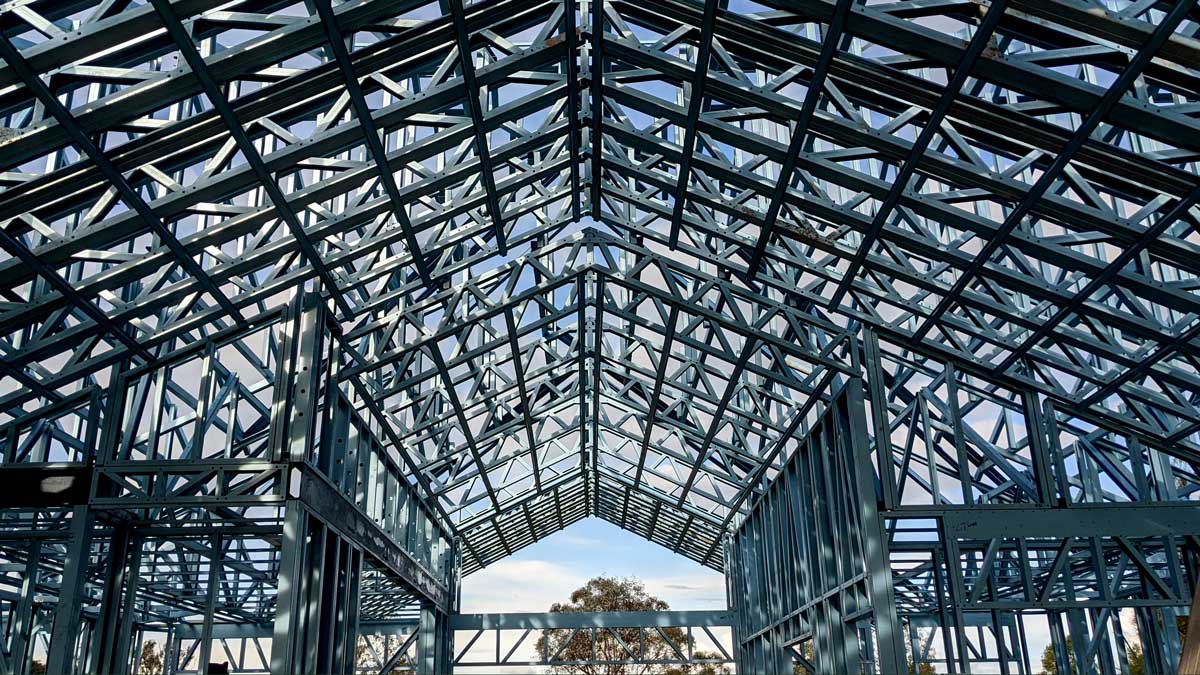
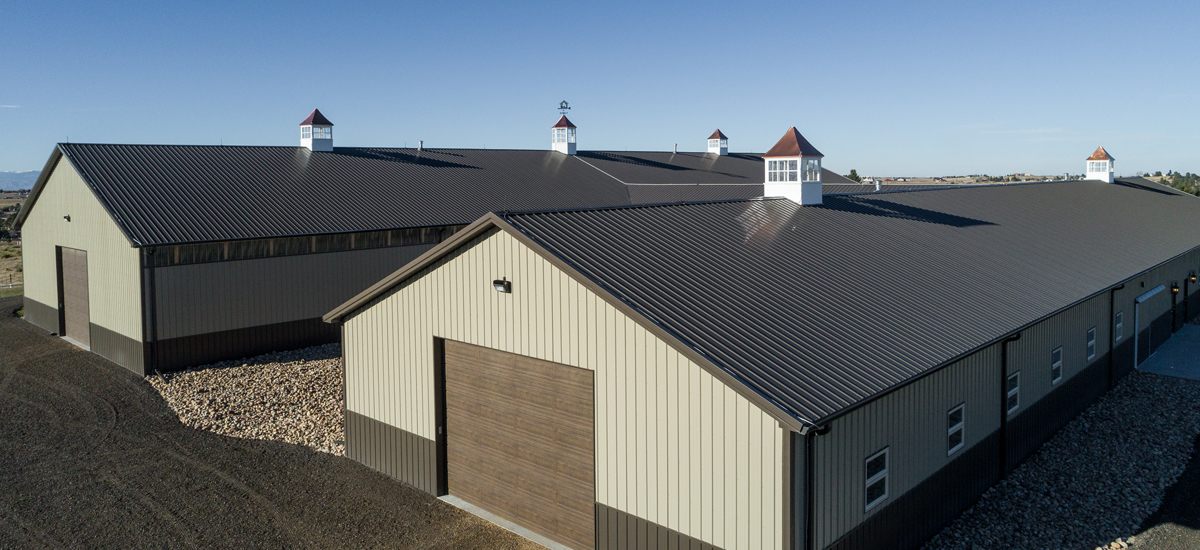
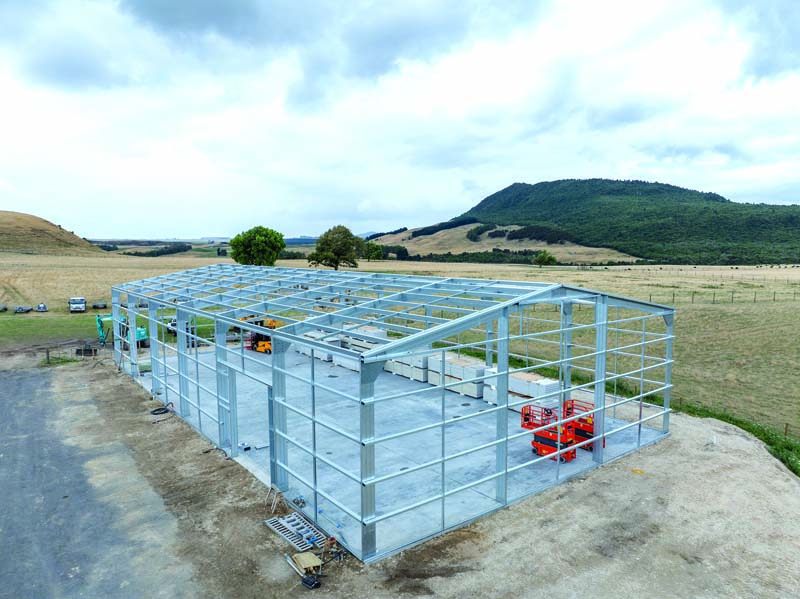
The second project is bigger, and older than it looks. About 20 years ago Schweiss manufactured seven steel buildings. Door sales were climbing, the company ran short of people to do both, and it set buildings aside to concentrate on doors. Buildings are now back in development, with no launch date set. The aim is to sell the door and the building envelope as a package.
The company is candid that timing depends on the core business. If door sales ever level off and it goes looking for another product line, “it would be buildings,” it said. “Time will only tell.”
The logic is easy to follow. On a hangar or a big farm shop, the opening is the hardest part of the structure to engineer, and the door maker already knows the loads. The freestanding header moved some of that responsibility from the building supplier to Schweiss five years ago, and the tilt-up moves more of it to the footings. A package extends single-source accountability from the door to everything it hangs on.
The obvious risk is channel conflict. Schweiss doors reach the market partly through builders and steel building companies, and a door maker selling buildings could see them as a new competitor. The company sees it differently. “We work with everyone from steel building companies to end users,” it said, and a package would be “a convenient option for all of our customers who are not in the building business.” It also notes that many steel building companies do not manufacture their own buildings; for them, Schweiss would be one more manufacturer to buy from.
Metal building manufacturing is still a scale business with entrenched suppliers, and a company of 65 people will again be choosing where to spend its factory time, as it did 20 years ago. This time it has a much bigger plant to work with.
The 14-by-14 in Franklin, the one its builder says he got wrong in every respect, still goes up and down. Schweiss is betting that the next time a customer asks for a big door, he can sell them the building around it as well.
Schweiss Doors at a Glance
- Founded: 1980 (first bifold door); the shop dates to the 1970s
- Headquarters: Schweiss family farm in Renville County, Minnesota, equidistant from Hector and Fairfax; address: Hector, Minn.
- Founder and owner: Mike Schweiss
- Ownership: Private and family-owned; sales figures not disclosed
- Employees: About 65
- Plant: About 350,000 square feet
- Market mix: 40% aviation, 40% agriculture, 10% commercial and industrial,10% Designer Doors
- Products: Bifold liftstrap doors, one-piece hydraulic doors, Designer Doors, cable-to-strap conversion kits; patented tilt-up door in final design; metal buildings in development
- Size range: 6 to 140 feet wide and up to 70 feet tall (2021); taller doors now in engineering
- Largest bifold delivered: 90 by 61 feet, Cape Canaveral, 2015
- Tallest in engineering: 68-by-74-foot clear opening, 86 feet overall
- Website: SchweissDoors.com
Where The Doors Go
- Agricultural: Clear width and height for combines, sprayers, planters, and semis as equipment keeps growing.
- Aviation: Private hangars, FBOs, corporate flight departments, maintenance facilities, and museums.
- Commercial: Storefronts and dealerships where security and appearance both count; frames accept nearly any exterior material.
- Industrial: Manufacturing plants, loading areas and equipment bays with heavy, frequent use.
- Marine: Some of the tallest openings in the business, for yacht construction, storage and repair.
- Residential: Garage doors clad to match the house, so the opening blends into the exterior.
Timeline
1971: Mike Schweiss graduates from high school and goes to work on the family dairy.
1976 Drought year: With three employees in the shop, he leaves dairying to manufacture full time.
1980: A conversation at a wedding dance leads to the first Schweiss bifold, a 14-by-14 for a county highway shed in Franklin.
1990: A trip to the EAA fly-in at Oshkosh opens the aviation market.
Late 1990s: One-piece hydraulic door added.
1998: Schweiss begins the liftstrap patent.
Mid-2000s: Schweiss builds seven steel buildings, then sets buildings aside to keep up with door demand.
2008: First doors for SpaceX.
2012: Red Power hydraulic pump introduced.
2013: Liftstrap conversion kit offered for cable doors of any make.
2015: 20,000-square-foot electrical building opens; 90-by-61-foot bifold ships to Cape Canaveral.
2021: Freestanding, self-supporting header frame for hydraulic doors.
2023: New weld shop opens at the plant, showcasing freestanding doors.
2024: Schweiss inducted into the Minnesota Aviation Hall of Fame; production begins on 228 doors for Dubai.
2026: Tilt-up door design about 75% complete; tallest doors to date in engineering; metal buildings in development.