
Originally Published as: Preventing Heat Conduction: Best Practices for Insulating Light-Gauge Steel Structures
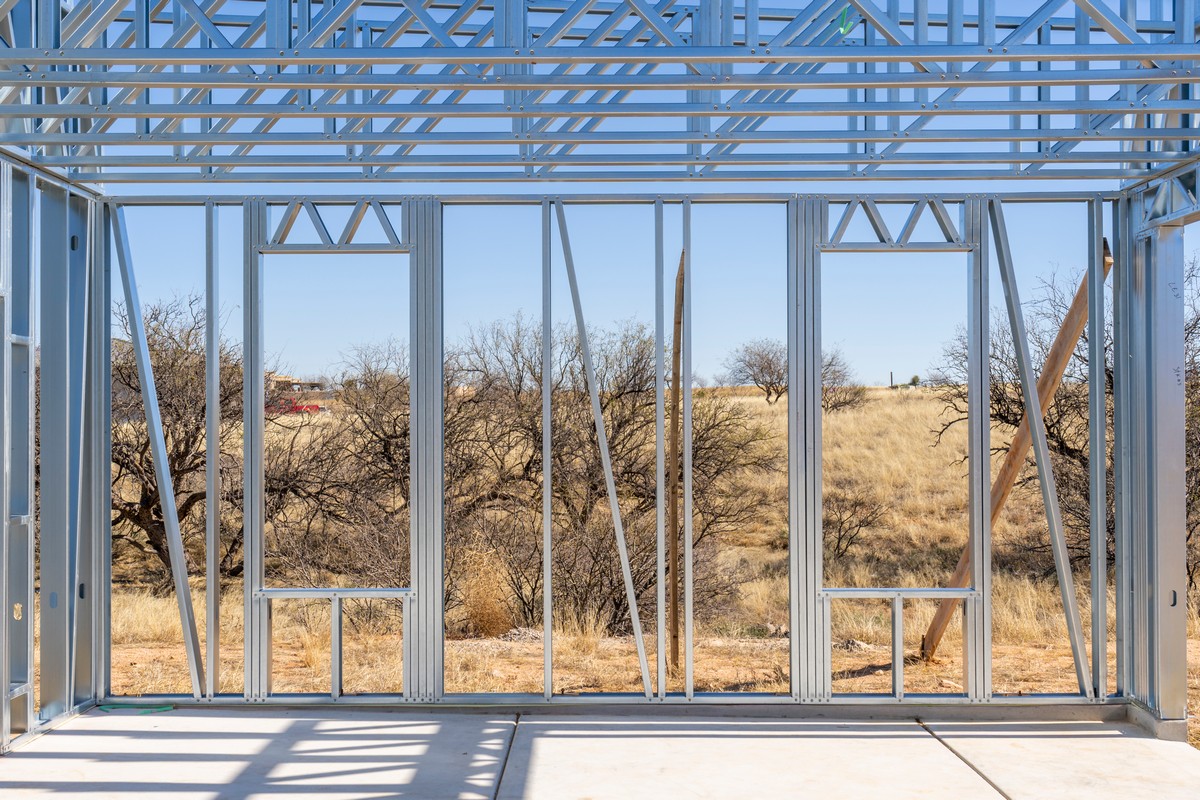
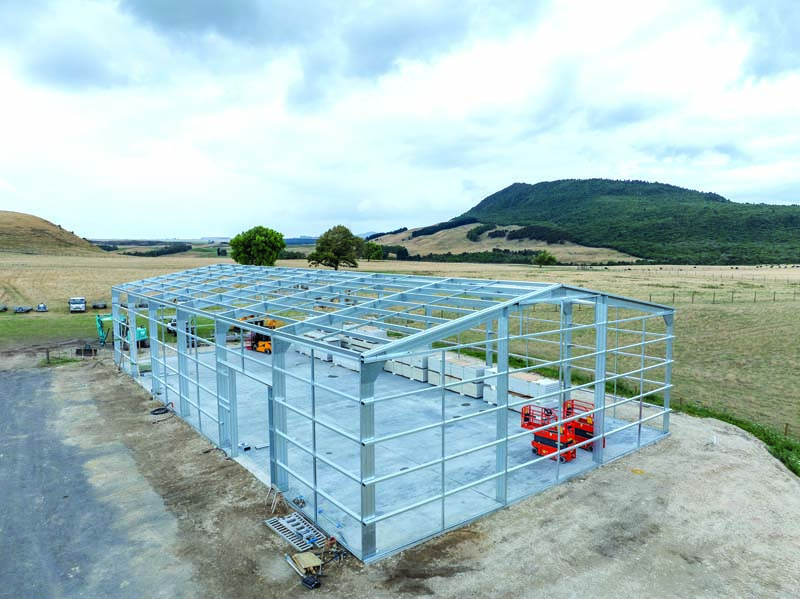
Light-gauge steel framing has become a common choice in residential, commercial, and agricultural construction. Its advantages are clear: it’s straight, dimensionally stable, lightweight, noncombustible, and resistant to rot, termites, and many of the problems associated with wood framing. But steel has one significant drawback when it comes to building performance—it’s an excellent conductor of heat.
Because steel conducts heat far more efficiently than wood, it creates what is called thermal bridging. In simple terms, anywhere a steel member passes through the building envelope, it can carry heat in or out, bypassing the insulation you installed between studs, joists, or rafters. The result is lower effective R-values, higher energy costs, and in some climates, a greater risk of condensation problems.

“When we build with steel the first thing people notice is how straight and clean the framing is,” says Nolan Woody, Operating Partner at Curbed Construction. “The second thing they notice, usually after the first utility bill, is how fast heat transfers if insulation isn’t handled right. Thermal bridging can cut the performance of a wall in half. If we don’t plan for continuous insulation up front, the owner ends up paying the difference every month.”
Why Thermal Bridging Matters
Most batt insulation, such as fiberglass or mineral wool, is designed and tested assuming it fills the space between framing members. In a steel wall with studs spaced 16 or 24 inches on center, however, those studs can reduce the effective R-value of the wall assembly by as much as 50% compared to its rated performance.
For example, an R-19 fiberglass batt installed between wood studs might perform close to its rated value. The same batt installed in a steel stud wall may only deliver an effective R-9 or R-10 because the steel members bypass the insulation.
The Role of Continuous Insulation
The most effective way to deal with thermal bridging is to add continuous insulation (CI)—a layer of insulation installed on the exterior side of the framing, running uninterrupted across studs, joists, and other members.
Common materials used for CI include:
- Rigid foam boards (polyiso, XPS, EPS)
- Mineral wool boards (rigid or semi-rigid)
- Spray-applied insulation (closed-cell spray foam, when used as a continuous layer)
By covering the steel with an uninterrupted insulating layer, thermal bridging is significantly reduced.
“Continuous insulation isn’t just about meeting code,” Woody explains. “It pays back in comfort and durability. If you skip it, you’re basically building in a problem that will cost more over the life of the building.”

Combining Cavity and Continuous Insulation
Most builders use a hybrid approach: cavity insulation inside the steel framing combined with continuous insulation outside.
“On our mixed-use commercial PEMB projects, insulation and soundproofing needs vary from one space to another,” says Woody. “The climate-controlled areas are where performance really matters, while the warehouse side can be more cost-conscious. What we’ve found works best is rolled batt or spray foam insulation on the metal exterior walls, and then batt insulation on the perimeter and interior walls of the conditioned space. That balance has proven to be both reliable and cost-effective.”
Moisture and Air Control
Because steel is such a good conductor, condensation control is crucial. Even minor air leaks can lead to moisture accumulating inside wall or roof assemblies.
“Steel is unforgiving with moisture,” Woody notes. “On one job we had a few unsealed penetrations around mechanical lines and it led to condensation inside the wall cavity. Within months fasteners were corroding. Since then we make it a point to seal every joint and transition carefully.”
Closed-cell spray foam can provide additional protection. “It adds R-value and helps seal where steel tends to sweat,” Woody explains. “I don’t treat it as the only line of defense, but in some assemblies it gives the owner peace of mind that condensation won’t become a problem.”
Proper detailing of air barriers, vapor retarders, and drainage planes is essential. Builders should ensure air barriers are continuous and penetrations are sealed, and vapor control layers are positioned according to the building’s climate zone.

Roof and Ceiling Assemblies
Roofs framed with light-gauge steel present similar challenges: thermal bridging and condensation.
“With steel roofs, especially low-slope systems, insulation mistakes show up quickly,” says Woody. “The approach that has worked best for us is combining above-deck insulation with batts inside the structure. That gives the right performance and keeps call-backs down.”
Above-deck insulation—rigid foam or mineral wool boards—is particularly effective at breaking thermal bridges and maintaining consistent surface temperatures across the roof deck.
Moisture Management from the Ground Up
“Moisture control and insulation really start in the slab,” Woody adds. “Using rigid insulation and a commercial vapor barrier system helps keep moisture from escaping through the concrete and into the building.”
Moisture is the long-term threat for all steel-framed assemblies. “Drainage, flashing, and site grading are just as important as the insulation itself,” Woody says. “In metal buildings the base plates and window details are usually what make or break the envelope.”
Code Compliance
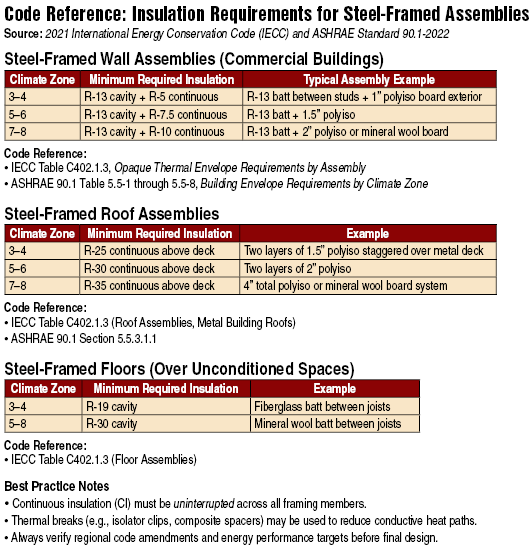
Builders should always verify their insulation strategies meet local codes. Most reference ASHRAE 90.1 or the International Energy Conservation Code (IECC), which set minimum R-values for steel-framed assemblies.
In many climate zones, a steel-framed wall might require R-13 cavity insulation plus R-5 continuous insulation to comply. Without CI, meeting these standards is nearly impossible. Energy codes continue to tighten, so planning hybrid assemblies now helps future-proof projects.
The Bottom Line
“At the end of the day, a metal building can be every bit as comfortable and efficient as any other type of structure,” Woody concludes. “You just have to respect the physics of steel, plan for thermal bridging, manage moisture, and treat insulation as an investment instead of an afterthought.”
Light-gauge steel framing offers outstanding structural performance and durability. With proper insulation design—balancing cavity and continuous insulation, controlling air and moisture, and following code—builders can ensure these structures are energy-efficient, comfortable, and built to last.