Originally Published as: Air Leakage Testing: Why and How It’s Done
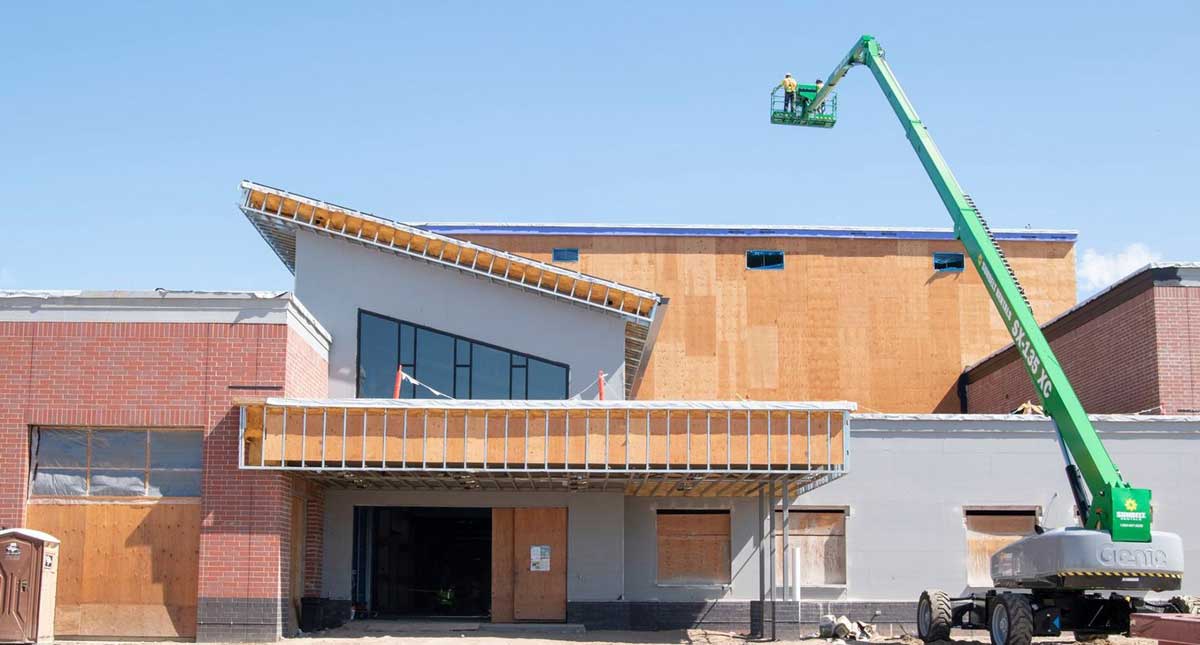
Building contractors are always looking for new and improved ways to ensure the longevity of the build and increase customer satisfaction. Air leakage testing is becoming more and more popular and is even required in some states. Metal buildings in particular can offer greater difficulty due to the difference in materials used.
Air leakage testing for metal buildings was first introduced by the International Energy Conservation Code in 2012 (NIA’s Metal Building Laminator Committee). Since then, there have been several addenda with the most recent one being added in 2024. Overall, 35 states have adopted an edition of the IECC since 2012 (National Association of Home Builders). The goal is for all 50 states, as well as the District of Columbia and Puerto Rico, to adopt an edition to help increase energy efficiency, lower energy bills, extend HVAC lifespan and increase comfort and indoor air quality.

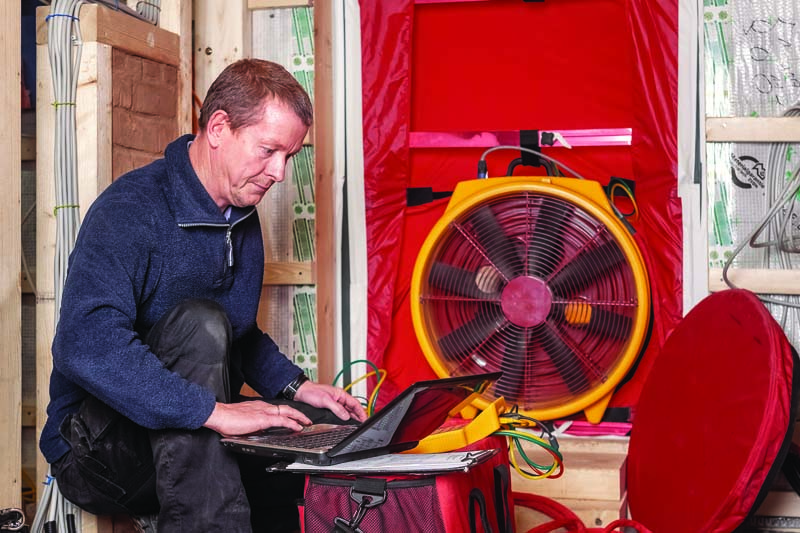
This process of air leakage testing involves three major components: incorporating a blower door, visual inspection and infrared pictures (NIA’s Metal Building Laminator Committee).This should be done during or at the end of construction; before the building is inhabited. The testing company will come in to determine the square footage and whether or not the building can be tested as one entire unit or if it will need to be done in sections. After this, it will be decided how many fans and how much pressure will be used during testing.
An inspection of the building is also done to ensure there are no obvious areas where air leakage will occur. This usually includes HVAC runs, plumbing and drain pipes. Some sort of temporary seal will need to be placed over these openings, this needs to be a sealant that can stand up to the pressure changes that will occur during the testing process. For example, painter’s tape will not be sufficient. If everything checks out well, all interior doors will be propped open, and all exterior windows and doors will be closed and locked (BC Housing).
One or multiple exterior doors —depending on building size — will be selected to be used for fan placement. The door will be sealed with a special plastic sealant that has an opening for the fan. A small tube will also be run from inside the building to the outside where it will connect with a manometer to read pressure changes (BC Housing). Once everything is fully sealed, a certain amount of pressure will be released into the building using the fan(s), and pressure changes will be recorded.
Beyond that, thermal imaging is also used to check for any ‘hot spots’ during and after testing. Smoke testing can also be done which involves using a smoke machine inside the building while someone on the outside watches for any signs of leakage.
Once testing is completed, it will need to be determined if the building passed. In the 2012 edition of the IECC standards, there are three compliance options. The first is that material must have an air permeability of no greater than 0.004 cfm/sq. ft., the second is the assemblies of materials and components should not exceed 0.04 cfm/sq. ft., and the third option is the whole building air leakage test should not exceed 0.4 cfm/sq. ft.
If the air leakage testing does not exceed these levels, the building passes the code and can be inhabited. If the building does not pass, it will need to be reassessed after appropriate corrections are made.
There are several potential problem areas in metal buildings. The first of these is dissimilar material surfaces which includes wall bases, windows and doors. Secondly, intersections or changes in air barrier configuration can pose a threat. Examples of these include wall to wall and wall corners. Lastly, penetrations such as HVAC, electrical, plumbing and canopy framing members can increase the chances of leakage (Z-Tech Consulting LLC). Once the areas of concern are located, some type of new sealant will need to be placed to ensure the building can pass the repeat testing. (Z-Tech Consulting LLC)
Air leakage testing for metal buildings was first introduced by the International Energy Conservation Code
in 2012.
The Metal Building Manufacturer’s Association (MBMA) website, offers a multitude of educational and technical resources. One resource in particular, titled Best Practices to Comply with Whole-Building Air Leakage Testing Requirements for Metal Building Systems, goes into great detail on what a contractor can do to prevent easily avoidable issues with air leakage in metal buildings. This encompasses tips for all of the problem areas stated above as well as quality control and quality assurance.
With all of that being said, there are plenty of reasons that a contractor would want to go through air leakage testing even if it is not required in their state. After all, air leakage does not only affect whether or not a building will pass code, it also will affect the pocket book of the building owner, cause issues with internal temperature and impact air quality (Blue Green Engineering). With unwanted air flow to the outside of the building, usually from poorly sealed windows or doors, heating and cooling appliances will have to work harder to maintain the desired temperatures and avoid unwanted temperature differences. This will shorten the lifespan of the equipment and cause the owner to spend more money on replacements. Cracks or air leakage areas not only let air out of the building but also let allergens and dust back in, which can increase health issues and cause additional damage to the internal equipment (Blue Green Engineering).
It should also be noted that since 2012, roughly 67% of states have adopted some form of the International Energy Conservation Code, indicating at some point your state may be added to that list. If contractors are already meeting some version of the code, even if it is not yet required, they will be prepared for it when the time comes. Not only will this be beneficial to the contractor, but will also improve client satisfaction.
Overall, the International Code Council has projected that between the years of 2010 and 2040, with the adoption of the IECC residential and commercial buildings will save roughly $126 billion in energy costs, 841 MMT of avoided carbon dioxide emissions, and 82 quads of primary energy (International Council Code). According to the ICC, these amounts equate to the emissions of 177 million passenger vehicles, 245 coal power plants or 89 million homes. Although this testing adds another step to construction, it will help save a large sum of money in the long run.
Citations
- BC Housing. “Whole-Building Airtightness Testing.” Youtube, Google, 11 Mar. 2022,
- Blue Green Engineering. “What Is Building Air Leakage and Why Does It Matter?” Blue Green Engineering, 30 May 2025, bluegreeneng.com.au/building-air-leakage-why-it-matters/.
- International Council Code. “IECC Compliance.” ICC, 28 Oct. 2024, www.iccsafe.org/advocacy/iecc-compliance/.
- National Association of Home Builders. “Standards Codes & Nahb.Org/Codes State Adoptions of The.” National Association of Home Builders, Nov. 2024, www.nahb.org/-/media/NAHB/advocacy/docs/top-priorities/codes/code-adoption/state-adoption-status-iecc-nov-2024.pdf?rev=6d9ff40d170448e0aab727d0d016a488&hash=041003E9F4973D12D7450B7821215E33.
- NIA’s Metal Building Laminator Committee: This article was written by a task force from NIA’s Metal Building Laminator Committee. The member companies that make up this committee , and NIA’s Metal Building Laminator Committee. “Metal Building Insulation and Air Leakage.” Insulation Outlook Magazine, 2 Oct. 2024, insulation.org/io/articles/metal-building-insulation-and-air-leakage/.
- Z-Tech Consulting LLC. “MBMA Releases Best Practices Guide for Air Leakage Testing.” MBMA, 12 Sept. 2023, mbma.com/news/mbma-releases-best-practices-guide-air-leakage-testing.