
Originally Published as: Break the Bridge: Why Thermal Breaks Are the Most Overlooked Line Item in Your Insulation Spec—and What It’s Costing Your Customers
You spec the fiberglass. You installed it correctly. You hand the building over to the owner and tell them it’ll be comfortable year-round. Then January rolls around, the heating bill shows up, and nobody’s happy. Sound familiar?
If you’ve been in the metal building game for more than a few seasons, you already know the culprit: thermal bridging. The steel members that make your buildings strong and durable are the same ones quietly hemorrhaging heat every hour of every day through every purlin and girt in the roof and wall assemblies. Standard fiberglass blanket insulation doesn’t stop it. Neither does double-bubble reflective insulation used alone. And the R-value stamped on the roll you put in? Once that insulation gets compressed at the structural connection points, that number becomes largely theoretical.
The solution isn’t a mystery. It’s a thermal break—a low-conductivity material strategically placed between the exterior metal panel and the steel framing below it. The concept is straightforward. Getting builders and owners to understand why it matters, and to spec it from day one, is where the real work starts.
We sat down with three companies deep in the metal building insulation and thermal performance space—Dutch Tech Industries, rFOIL Reflective Insulation, and Thermal Building Concepts—to get a ground-level look at where the industry stands, what’s working on real job sites, and why addressing thermal bridging isn’t a luxury upgrade. It’s table stakes for any conditioned metal building in today’s energy code environment.
The Problem in Plain English
Steel is one of the most thermally conductive common building materials on the planet. It conducts heat at a rate roughly 1,400 times faster than a comparable thermal break material. That’s not a typo. When a steel purlin runs from your exterior roof panel down into the building’s conditioned interior, it acts like a radiator fin in reverse—pulling heat out of the building in winter and pumping it back in during summer.
In a conventionally insulated metal building, the fiberglass blanket lies between the framing members and the exterior panels. But right where it should be doing the most work—at the purlin or girt flange—it gets compressed. Compressed insulation doesn’t insulate. The air pockets that give fiberglass its thermal resistance get squeezed out, and you’re left with little more than a thin layer of matted glass fiber at exactly the spot where the thermal bridge is worst.
The result is a building that performs far below its rated R-value. Research from organizations, including the Pacific Northwest National Laboratory, has shown that thermal bridging in metal building roofs and walls can reduce effective R-values by more than 50% compared to the labeled value. Some studies on wall assemblies put it even higher for buildings with dense girt spacing.

Energy codes have been tightening for years, and ASHRAE 90.1 and the IECC now demand that metal buildings meet assembly U-value targets that simply can’t be achieved with single-layer blanket insulation systems that don’t address thermal bridging. If you’re still quoting single-layer systems to owners of conditioned buildings without having the thermal bridge conversation, you’re setting up future problems—for them and for you.
Reflective Insulation Does the Heavy Lifting on Radiant Load
Before you can understand why thermal breaks matter, it helps to understand what standard insulation does and doesn’t address. Mass insulation—fiberglass, mineral wool, rigid foam—handles conductive and convective heat transfer. What it doesn’t stop is radiant heat, which accounts for a substantial portion of heat gain and loss in metal buildings. That’s where metalized reflective insulation products come into play.
The best reflective insulation products for metal buildings are built around the physics of metalizing—applying vaporized aluminum to a substrate to create a highly reflective surface. Top-tier products block up to 97% of radiant energy, a figure that becomes significant when you consider that radiant heat transfer can account for up to 75% of total building heat gain or loss, depending on the application.
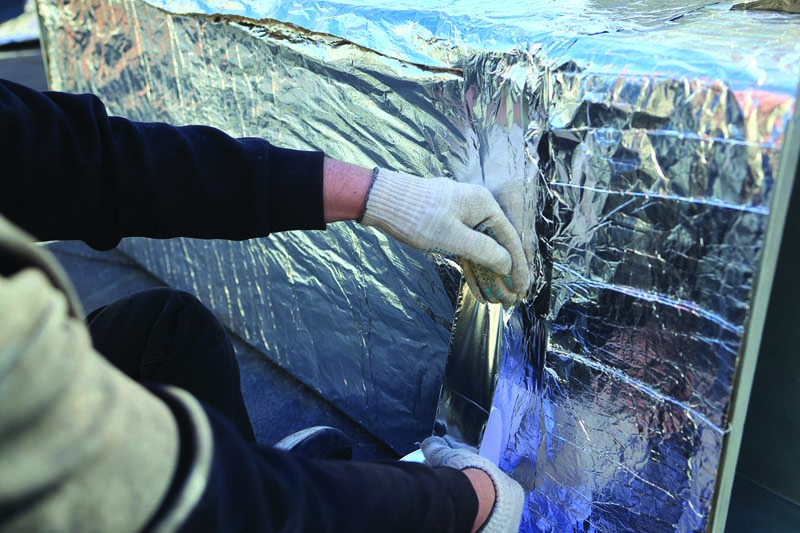
What separates high-quality reflective insulation in the field isn’t just the thermal specs—it’s the material construction. Installers have historically griped about bubble-wrap-style reflective insulation because it tears, sags, blows off in the wind during installation, and is difficult to get wrinkle-free on large roof spans. Products with woven polypropylene or scrim-reinforced backings address all of those complaints directly. Staples hold. Edges don’t pull away. The material can be wrapped around an entire building at once without babysitting it in breezy conditions.
Practical roll dimensions—designed around how metal buildings are actually built—matter more than builders sometimes realize at spec time. For a standard 40-by-60 structure with 12-foot walls, predictable coverage per roll makes a real difference when you’re quoting a job and ordering materials.
The broader point that resonates throughout the industry is that reflective insulation and mass insulation address fundamentally different heat transfer mechanisms. They’re not competing products; they’re complementary. A well-designed metal building insulation system typically uses both, layered strategically to address the full spectrum of thermal challenges.
Reflective Performance That’s Built North American Tough
Some insulation manufacturers in the metal building space have been at this for more than three decades, and the track record shows. The most durable reflective insulation systems have built their reputations on a straightforward proposition: control heat transfer, manage condensation, and hold performance over time—without the degradation problems that plague traditional fiberglass systems in wet or humid environments.
One of the performance arguments that often surprises builders is about R-value stability over time. Fiberglass insulation can lose more than a third of its effective R-value in the first two years after installation in metal building applications—due to compression, moisture infiltration, and settling. Quality reflective products don’t compress, don’t collapse in moisture, and don’t degrade in the same way. The R-value you install on day one is the R-value the building owner has on day 3,000.
The ability to act as a vapor barrier is particularly important in metal building applications. Condensation is a persistent enemy in steel buildings where warm, moist interior air comes into contact with cold structural surfaces. A double-bubble reflective core acts as a thermal break between the exterior metal and the conditioned interior, keeping connection surfaces above the dew point and shutting down the condensation cycle before it starts.
Product innovation in this category has been focused on post-frame applications, where woven scrim mesh constructions deliver outstanding tear resistance when stapled to wood purlins—a pain point that has historically plagued reflective insulation on post-frame structures. Multiple width and facing options give builders and installers the flexibility to spec the right configuration for each application.
Market recognition from publications like Metal Roofing Magazine speaks to the kind of credibility that comes from decades of consistent product performance in demanding applications—the sort of track record that matters when an owner is making a long-term investment in their building envelope
Closing the Loop: The Case for Thermal Spacer Blocks
Here’s where the conversation gets granular—and where many builders are still leaving significant performance on the table. Even if you’ve done everything right with your insulation products, the steel purlin or girt sitting in your roof or wall assembly is still a thermal highway right through your envelope. Reflective insulation addresses radiant load. Fiberglass blankets handle the convective and conductive field between framing members. But neither one eliminates the direct metal-to-metal contact at the structural connection points.
That’s the gap that thermal spacer blocks fill—and it’s a gap that specialists in thermal break systems for metal buildings have made their core business.
The physics here aren’t complicated, but they’re often misunderstood. When you place a thermal spacer block between a metal roof panel and a steel purlin, you’re doing two things simultaneously: you’re interrupting the direct conductive path between the exterior and the structural framing, and you’re creating additional cavity space that allows your insulation to maintain closer to its full designed thickness at the connection point.
The result is a continuous insulation layer—what ASHRAE defines as insulation that is uncompressed and continuous across all structural members, without thermal bridging from fasteners or service openings. That definition is the benchmark your buildings need to hit to comply with current ASHRAE 90.1 and IECC requirements in most climate zones for conditioned occupancies.
The payoff numbers are real and documented. Hot box testing on assemblies incorporating thermal spacer blocks has demonstrated insulation performance improvements of up to 100% in certain screw-down roof configurations compared to the same assembly without them. Return-on-investment timelines of 12 to 18 months for energy savings are supported by real-world building data. That’s not a hard argument to make to a building owner who’s going to be paying utility bills for the next 30 years.
There’s a structural dimension to this conversation that builders sometimes overlook. A thermal spacer block isn’t just foam sitting between two steel surfaces. It has to have the compressive strength to support the loads at the purlin connection without deforming to the point where it loses its thermal benefit. Products engineered specifically for this application carry tested structural data. Generic foam tape does not. That distinction matters when your building manufacturer is reviewing the insulation spec.
Building the System: How It All Works Together
The most effective metal building insulation strategies aren’t about picking one product. They’re about layering solutions that address different parts of the thermal problem. A high-performance conditioned metal building typically incorporates at least three elements working together.
At the base level, a reflective barrier handles the radiant heat load from the roof and wall panels. Installed between the exterior panels and the structural framing, it reflects radiant energy before it can be absorbed into the building’s thermal mass and re-radiated into the conditioned space. It also provides a vapor management layer that reduces the risk of condensation at the panel surface.
The second layer is mass insulation—fiberglass blanket insulation filling the cavity space between framing members. This accounts for the bulk of convective and conductive heat transfer within the assembly’s field. In climate zones requiring higher performance, double-layer systems with perpendicular upper layers help maximize the usable insulation thickness without thermal compression losses.
The third piece—and the one that ties it together—is the thermal break at the structural connection. Thermal spacer blocks at purlins and break tape at girt flanges prevent the insulation system from being short-circuited by direct steel-to-steel conduction at every fastener point. Without this, your field R-value doesn’t reflect what’s actually happening at the framing, and your whole-assembly U-value will likely fail to meet code requirements for conditioned occupancies.
The interaction between these layers is where builders who understand the full picture pull ahead of the competition. An owner who gets a building that performs to its rated spec—one that heats and cools predictably, manages moisture without condensation issues, and arrives at energy code compliance without the expensive retrofit conversation two years later—is an owner who calls you back for the next project.
The Code Reality You Can’t Ignore
Energy codes have moved aggressively in recent years, and metal buildings haven’t been exempt from the shift. ASHRAE 90.1-2019 and the 2021 IECC both contain prescriptive and performance-based requirements for metal building wall and roof assemblies that are significantly more stringent than the versions that were standard practice a decade ago.
The key concept is continuous insulation—CI in code language. The prescriptive approach for many climate zones now requires continuous insulation in addition to the cavity insulation between framing members. For metal building applications, thermal spacer blocks at purlins are one of the recognized strategies for achieving that continuous insulation requirement without resorting to expensive add-on rigid board systems.
The important nuance for builders is that the tested assembly matters. Many hot-box-tested insulation systems that are used to demonstrate code compliance are tested with specific thermal block products as part of the assembly. If you substitute a different block or omit the block entirely, you can no longer claim the tested performance value. That means the R-value you put on the compliance documentation may not reflect what was actually installed—a liability position no builder wants to be in on a commercial or institutional project.
Working closely with your insulation suppliers to understand which tested assemblies apply to your specific building design, climate zone, and occupancy type is the kind of pre-job diligence that separates builders who lead with expertise from those who find out after the inspection.
The Bottom Line
Thermal bridging is not a new problem. The steel members in metal buildings have been conducting heat through envelope assemblies since the first post-frame structure went up. What’s changed is the energy code environment, the availability of tested solutions, and the expectations of building owners who are more energy-cost-aware than any previous generation.
The good news is that the products and systems exist to address it—and they’re not cost-prohibitive when specified from the beginning of the project. High-performance reflective insulation handles radiant heat loads with durable, installer-friendly systems that maintain performance for the life of the building. Proven reflective platforms with decades of track record in metal building applications deliver code-recognized performance and condensation control. And specialized thermal spacer block solutions interrupt thermal bridging at the connection points where blanket insulation can’t go.
Together, they represent a complete approach to metal building thermal performance—one that goes beyond stamping an R-value on a roll of insulation and calling it good.
The bridge isn’t going to break itself. But it’s not hard to break, either—if you understand where it is and what to do about it.
FOR MORE INFORMATION
- Dutch Tech Industries – www.dutchtech.com
- rFOIL Reflective Insulation – www.rfoil.com
- Thermal Building Concepts – www.thermalbuildingconcepts.com